Hallways and staircases are seen from several levels and used throughout the day. A good finish depends on access, protection and consistent detailing across walls, ceilings, doors, skirting, balustrades and mouldings.
Plan the route through the property
The stairs may be the only route between floors, so decide how work and drying time will be managed. Floor protection must remain secure without creating trip hazards, and tools should not block the route.
High ceilings or stairwells need a suitable access method chosen for the task. Stretching from a standard stepladder across stairs is not an acceptable substitute for proper planning.
Inspect the walls in changing light
Side light from upper windows can reveal filler edges, old roller texture and settlement cracks. Clean the surfaces, identify recurring movement and prepare repairs so they blend into the surrounding wall.
The same colour can look different between the ground floor and landing. Test samples at both levels before committing to a large area.
Keep lines consistent
Panel mouldings, dado rails and architraves create repeated edges. Small variations become obvious when viewed along the hallway. Use a clear colour and sheen schedule so every door, frame and trim detail is treated consistently.
Choose practical finishes
Entrances and stair walls receive contact from hands, bags and furniture. A compatible durable wall coating may be sensible, while woodwork needs a finish appropriate to the substrate and expected wear.
Higher sheen can improve cleanability but may highlight uneven preparation. Product guidance and the desired appearance both matter.
Work in an efficient order
Ceilings and high preparation normally come before walls and lower woodwork. Coordinate carpet, flooring, electrical work and joinery so finished decoration is not damaged by later trades.
View a genuine project
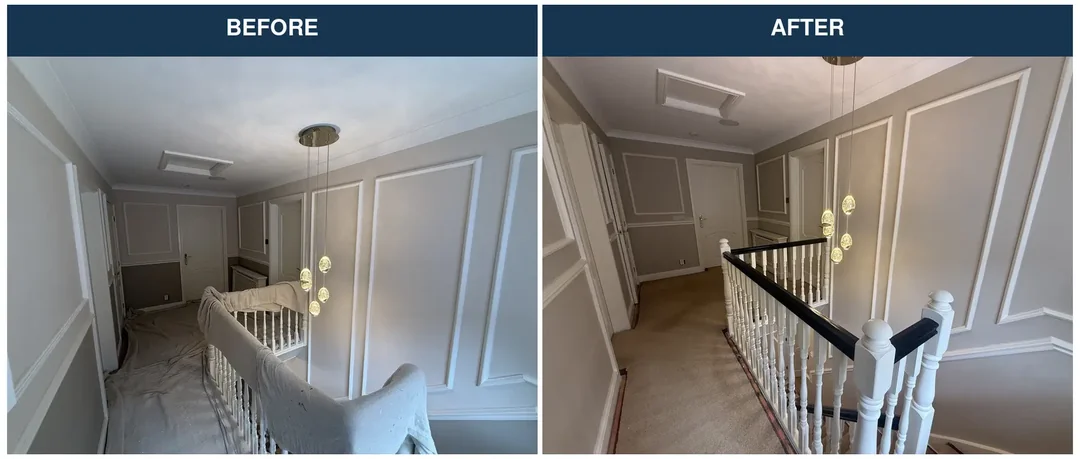
Our Whitegate case study near Vale Royal shows four before-and-after views of an entrance hall, staircase and landing. JP Whyte Decorators provides hallway and staircase decorating across Cheshire.
Start with wear patterns
Hallways show contact marks around switches, handrails, door frames and narrow turning points. Stair strings, newel posts and skirting also collect knocks. Inspect these areas closely so cleaning, filling and adhesion work is included rather than hidden by one quick coat.
Plan safe access and movement
A staircase is both a work area and a route through the home. Agree when it can be used, where tools will be stored and how children or pets will be kept away. Do not balance steps across stairs unless the equipment is specifically designed and set up for that use.
Choose finishes for maintenance
A durable, cleanable wall finish may be sensible in a busy hallway, while trim needs a compatible system on a properly prepared base. Higher sheen can make defects more visible, so the preparation standard should match the chosen finish.
Make the junctions consistent
The sharpness of the result is often judged at the meeting points: ceiling line, skirting, frames, spindles and wall colour. Decide which elements change colour and where transitions stop. Label leftover paint with room, product and colour so future touch-ups do not become a guessing exercise.
Would you rather have it done professionally?
Planning a decorating project in Cheshire? Call 07377 812846 or use the contact form for a free quote.
Get a free quote